
Ecommerce SEO consultant: online stores that sell more, not just get more visits
I’ve been doing SEO for online stores since 2017: architecture, categories, product pages, crawling and migrations, measured in orders and revenue, not rankings.
I’m Javier Santos Moreno, a working SEO consultant at agencies such as iSocialWeb Marketing and Comodoro Marketing. I’ve handled the SEO for stores selling olive oil, plants and trees, nursery plants and toys, on WooCommerce, Shopify and PrestaShop. Here’s how I work on an ecommerce store’s SEO, what results you can expect and what it costs.
In 30 minutes I’ll review your store with you and tell you whether SEO can move sales in your case, and where I’d start.

What an ecommerce SEO consultant does (and how it differs from an agency)
Ecommerce SEO has a problem that SEO for a corporate site doesn’t: scale. A store with 300 products generates thousands of URLs across categories, filters, pagination, variants and internal search. Google won’t crawl them all, and it certainly won’t rank the ones you want unless the architecture makes it easy.
My job as an SEO consultant for online stores is to decide which URLs deserve to exist, which should rank, which keyword each one targets and how they link to each other. Technical work and content come after that, but without those decisions the rest is noise.
Compared with an ecommerce SEO agency, what changes is who makes those decisions:
- You talk to me.The person who audits your store, defines the strategy and carries it out is the same person who answers your email.
- I decide by margin, not by volume.Ranking the category people search for most is pointless if it’s the one with the lowest margin. I look at your P&L first.
- A capped roster.Ten active clients at most. An online store needs continuous attention, not a quarterly review.
If your store turns over more than two million and needs a full-time content team, a specialist agency may suit you better. For stores somewhere between launching and consolidating, an independent consultant is usually faster and cheaper.
Three real online stores, with their graphs
Organic traffic from Ahrefs and Search Console. Each case has its own page with the starting point, the decisions we made and the order and revenue figures.

Olive oil ecommerce
A pivot to a gourmet range to compete against the sector’s giants. Key product and category pages ranked in a market with strong seasonality and brand comparison. Read the case →

Plant and tree ecommerce
Three sites consolidated into one and migrated to WordPress. Sustained growth in a competitive niche with a focus on categories and product pages. Read the case →
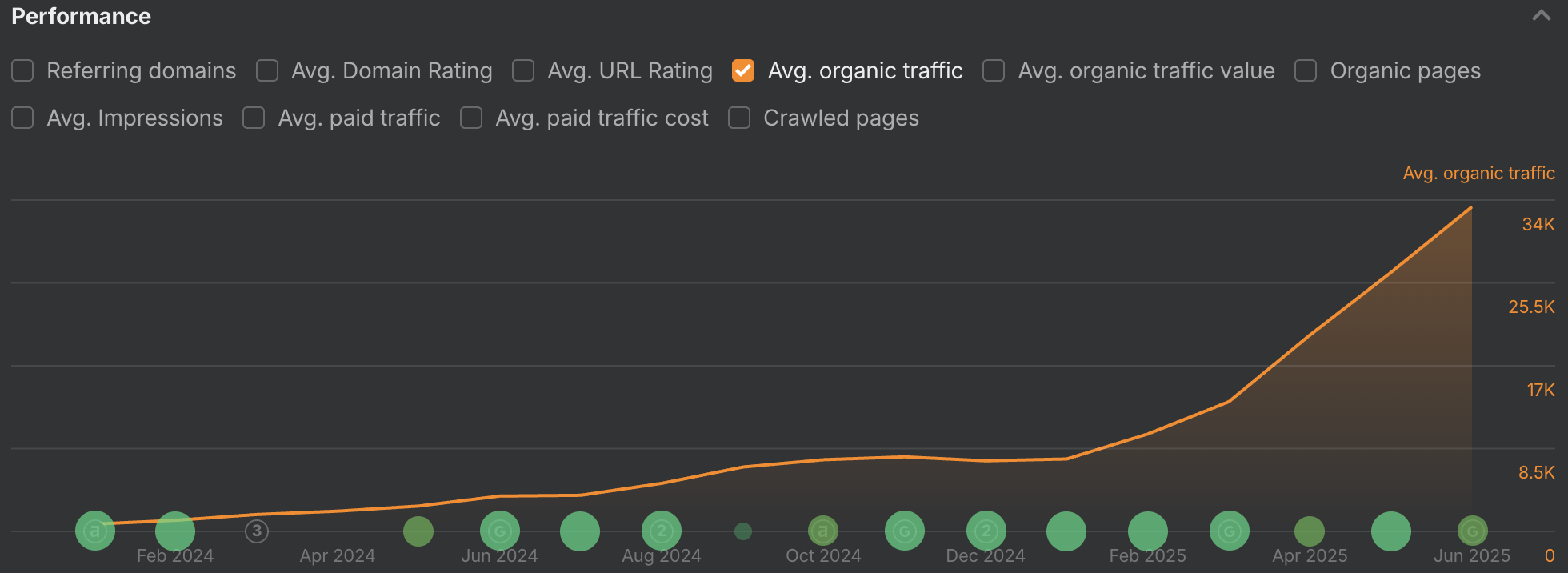
Online plant nursery
Shopify to WordPress migration and +700% organic growth in under six months, with a higher average order value and orders topping €6,000. Read the case →
How I work on an online store’s SEO, step by step
This is the order in which I tackle any ecommerce store. Not everything is always needed, but the order doesn’t change: business first, then structure, then technical, and content and authority last.
Before touching anything: business, margins and which products deserve to rank
I ask for sales history by category and product, margins and seasonality. That decides where the SEO effort goes. In the olive oil store, for example, the decision was to stop fighting for generic olive oil against the big brands and rank the gourmet range instead, where margin and conversion were a different story.
Keyword research for stores: categories, products, long tail and seasonality
Every URL in the store gets a search intent and a primary keyword: categories take the generic searches with purchase intent, product pages take product and brand searches, and the blog only takes informational searches that genuinely lead to a purchase. That avoids cannibalisation between category and product pages, the most common mistake I find in audits.
Architecture: levels, categories, subcategories and facets
Architecture decides what receives internal authority and what Google crawls. I define the maximum depth, which subcategories exist as their own URL and which are just a filter, and how sibling categories and related products link together. In the migration of the three plant sites, the new architecture is what made consolidation possible without losing rankings.
Category and product pages: what to optimise, and what to do with variants and discontinued items
On categories I work on the title, useful copy (not a filler paragraph at the bottom), product ordering and linking. On product pages, descriptions that answer what the buyer hesitates over before paying, images with controlled weight and structured data. Variants are grouped under a canonical URL and discontinued products redirect to their replacement or to the category, never to the homepage.
Crawling and indexing: facets, pagination, canonicals and crawl budget
This is where the most money is lost without anyone noticing. Filters generating thousands of indexable URLs, uncontrolled pagination, sort parameters and internal search pages in the index. I review logs and Search Console to see what Google actually crawls, and close off what adds nothing with robots rules, canonicals and noindex, so crawl budget is spent on the URLs that sell.
Structured data: Product, Offer, Review and BreadcrumbList
Price, availability, ratings and breadcrumbs marked up correctly so product pages get rich results and can appear in organic Google Shopping through Merchant Center. Validated one by one, because a broken schema in the product template breaks every product page at once.
Performance and Core Web Vitals for stores
Stores load slowly because of images, sliders, apps and third-party scripts. I work on the LCP of product and category pages, the CLS of listings and the loading of scripts that aren’t needed on every template. On mobile, where people actually buy, every second shows in conversion.
Internal linking, authority and content that actually works for a store
Internal linking channels authority to the categories and products we want to rank: menu, breadcrumbs, related products and buying guides that link to products. External authority is built with relevant editorial links once the foundations are in place. And the blog only gets written if it answers a question that ends in a purchase; otherwise it’s cost with no return.
WooCommerce, Shopify, PrestaShop and when to migrate
WooCommerce is where I have the most control: architecture, templates, structured data and performance can all be tuned without limits. It’s the platform I migrated two of the three cases on this page to.
Shopify is convenient for selling and rigid for SEO: the /collections/ and /products/ URL structure, limited control over crawling and dependence on apps for basic things. You can do good SEO on Shopify, but there’s a ceiling. When a store hits it, as the nursery did, migrating to WordPress with WooCommerce is the decision that has moved the most traffic across all my projects.
PrestaShop has a solid technical base and tends to fall short on facet control, on module layers that slow loading down and on duplicate product pages created by combinations.
A platform migration only makes sense when the current platform’s ceiling costs more than the move, and always with a URL inventory, a one-to-one redirect map and daily monitoring for the first weeks. If your store is on Shopify and you’re wondering whether to migrate, that’s a conversation for the intro session.
Measurement: what “selling more” means in data
For an ecommerce store, SEO is measured in orders, revenue and margin attributed to the organic channel, by category and by type of search. I set up Google Analytics 4 with full ecommerce tracking and cross Search Console with sales to see which searches buy and which only browse.
The monthly report answers three questions: what happened to organic sales, why, and what we decide for next month. Keyword rankings go in an appendix, not on the front page.
How much SEO for an online store costs
Ecommerce SEO strategies start from €1,000 per month. The final price depends on catalogue size, platform, industry competition and whether I implement or coordinate with your team. A one-off ecommerce SEO audit, with a prioritised action list, is quoted separately.
Below that figure you can’t work on architecture, crawling, product pages, content and measurement at the same time for a store with a real catalogue. And if the store turns over less than the SEO would cost, I’ll tell you in the intro session and we’ll talk about what to do first.
Intro session: €30 / 30 minutes
I review your store with you live and we come out with three things clear:
- Whether SEO can move sales in your case, or not yet.
- The two or three problems holding the store back right now.
- Where I’d start and with what level of commitment.
If we’re a fit, a tailored proposal follows. If not, you keep the diagnosis.
Which stores I’m a good fit for, and which I’m not
Stores that already sell and have stalled
They have revenue, but organic traffic has been flat for months or depends on brand searches and Google Ads. There are usually architecture and crawling problems nobody has looked at.
Stores about to migrate or consolidate
Moving from Shopify to WordPress, from PrestaShop to WooCommerce, merging several sites or a full redesign. It’s the moment when the most is won or lost.
Niche stores with margin
Own-brand, gourmet, specialist or local products, where competing with Amazon on price makes no sense but competing on specific searches does.
We’re not a fit if you sell generic, low-margin products competing on price alone, if the store has no sales yet and you want SEO to create them from scratch in two months, or if you need mass content production with a large team.
If what you want is to learn to make your store’s SEO decisions yourself, I also offer one-to-one SEO mentoring on your own project.
FAQs about ecommerce SEO
How long does SEO take to deliver results for an online store?
Do you work with large catalogues?
Shopify or WooCommerce for SEO?
Do you handle the store migration or just the SEO side?
What happens with Google Ads while SEO ramps up?
Do you rank stores in Google Shopping and marketplaces?
How much does SEO for an online store cost?
Do you work with stores outside Spain?
Let’s talk about your store
Book the intro session, I’ll review your store with you live, and you’ll come away knowing what’s holding back your organic sales and where I’d start.
Book an intro session · €30 →Roster capped at 10 active clients